
5 Ways Journaling Helps You Let Go and Trust God
Discover how Christian journaling helps you release control, find emotional freedom, and trust God daily through faith-based journaling practices.
IDENTITY IN CHRIST
Alberta
10/8/202510 min read


When Letting Go Feels Impossible
For years, I lived exhausted, not because I didn’t love God, but because I was trying to do His job.
I planned everything — my week, my month, my future.
I wanted to manage every outcome: how people responded to me, how my career unfolded, how my family turned out.
It was my way of keeping life from falling apart again.
But the more I tried to control things, the more anxious and restless I became.
There were nights I couldn’t sleep, my mind racing with what-ifs and worst-case scenarios.
And when exhaustion set in, I’d whisper:
“Lord, why do I feel so tired when I’m trying so hard?”
After my divorce, I reached a breaking point.
Therapy helped for a while, but deep down, I knew I needed more than strategies — I needed surrender.
That’s when I began journaling again.
Not fancy reflections or long essays, just honest letters to God.
Some nights, I wrote through tears: “Lord, I can’t do this anymore. Please take over.”
Other nights, I wrote words of gratitude, thanking Him for being my strength when I had none.
Over time, journaling became sacred ground. A space where I could lay down every burden and meet God in my honesty.
And somewhere between the ink and the tears, the surrender began.
Because journaling isn’t just writing. It’s releasing.
It’s a daily act of faith, a practice of loosening your grip and letting God take the lead.
If you’ve ever wondered how to truly let go and trust God, journaling might just be one of the most powerful, practical ways to start.
The Connection Between Writing and Trust
There’s something sacred about putting pen to paper or words to screen.
When we write, we slow down enough to see what’s really in our hearts.
“Do not be anxious about anything, but in every situation, by prayer and petition, with thanksgiving, present your requests to God.
And the peace of God, which transcends all understanding, will guard your hearts and your minds in Christ Jesus.” — Philippians 4:6–7 (NIV)
That’s exactly what journaling does.
It’s a way of presenting your requests, your fears, and your gratitude to God.
When you write, you give your worries form so that God can transform them.
Anxiety thrives in silence, but peace grows in honesty.
When we keep things bottled up, they multiply in our minds.
Writing them down before God breaks that cycle.
You might start your entry feeling tangled and overwhelmed.
But by the time you finish, you’ll often find a sense of calm that words alone can’t explain.
That’s the peace Philippians talks about — the kind that guards your heart.
Journaling is emotional release and spiritual connection.
It’s the quiet practice of saying, “Lord, I’m giving this to You.”
And with time, this daily surrender builds something stronger than control — it builds trust.
📖 If you’ve never journaled before, start today. Write a short note to God about one thing that’s heavy on your heart. Let it be your first act of letting go.
Feedback from our community
💬 “I never thought journaling could change my spiritual life — but after just a week, I felt lighter, more at peace, and closer to God than I’ve been in years.”
— Reader email
Stories like this remind me that God meets us right where we are — sometimes with nothing more than a pen and open heart.
5 Ways Journaling Helps You Let Go and Trust God
Let’s look at five ways journaling becomes a sacred companion in your surrender journey, helping you release control and build deeper faith in God’s timing, goodness, and presence.
1. It Reveals What You’re Clinging To
Sometimes we don’t realize what we’re holding onto until we write it down.
When you start journaling to let go, you’ll begin to notice patterns — things that keep surfacing in your words.
Maybe it’s a person, a fear, a dream, or a specific outcome.
Whatever it is, writing helps bring it into the light.
I remember one journal entry where I wrote, “Lord, I trust You,” and then three lines later, “Please make this situation turn out this way.”
That moment made me pause. I realized I wasn’t really trusting — I was negotiating.
That’s the beauty of journaling: it holds up a mirror. It helps you see yourself honestly, not to shame you, but to invite you into truth.
When you recognize what you’ve been trying to control, you can finally place it back in God’s hands.
Try this: Write the sentence, “Lord, what am I afraid to let go of?” Sit quietly, then start writing whatever comes. No filter. No judgment.
You might be surprised by what He shows you.
2. It Builds Consistency in Prayer
Journaling is prayer in motion.
When life gets busy, we often say, “I’ll pray later,” and then we don’t.
But when you journal, prayer becomes woven into your daily rhythm.
It doesn’t have to be long or formal.
Some days your entry might just be a few words: “Lord, today was hard, but thank You for staying close.”
Other days, it might be a full conversation — questions, reflections, verses, gratitude.
This habit of showing up before God, even in weakness, builds intimacy.
It’s how you begin to trust Him more naturally — because you’ve seen, over time, that He listens.
If you’re rebuilding your prayer life after a hard season, you might love my post on finding faith after loss.
It’s a gentle reminder that peace comes when we release control and let God hold what we can’t.
One of the most beautiful things about a journal is looking back months later and realizing: He answered that prayer.
Each page becomes a testimony of His timing, His grace, and His care.
Faith-based journal practices like this don’t just record your prayers; they record God’s faithfulness.
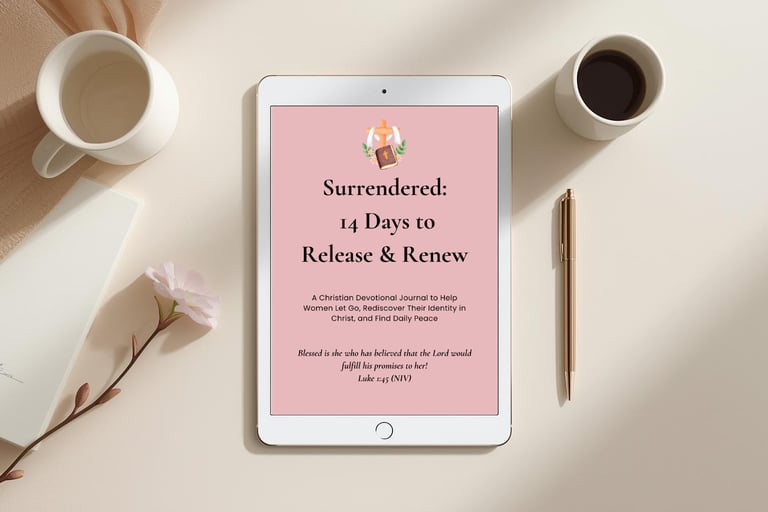
💛 Ready to make journaling part of your prayer life? Surrendered is a gentle devotional journal created to help you release control, draw closer to God, and stay consistent in prayer.
It’s coming soon so join the waiting list here to be the first to know when it launches.
3. It Invites Reflection Instead of Reaction
In a world that moves fast, journaling helps you slow down.
Instead of reacting to pain, confusion, or frustration, you take a pause. You reflect.
When you write, you create a sacred pause between what happened and how you respond.
That pause is where peace begins.
Many of my entries started out as rants, raw, unfiltered emotions.
But somewhere mid-sentence, the Holy Spirit would interrupt me with truth.
A verse. A reminder. A whisper that said: “You’re not alone in this.”
That’s how healing through prayer often happens — not all at once, but in quiet moments where God speaks between the lines.
If you struggle with overthinking or anxiety, this is powerful.
Because instead of spiraling, journaling helps you anchor.
It helps you process in God’s presence, not in your own strength.
Letting Go Journal Tip: When emotions rise, instead of reacting or texting someone, open your notes app or journal and write: “Lord, this is what I’m feeling right now…”
You’ll be amazed how often that moment diffuses what felt overwhelming just minutes earlier.
4. It Helps You See God’s Faithfulness
This might be my favorite part of journaling — looking back.
When you flip through old pages, you start to see a pattern.
The things you once worried about? God handled them.
The prayers you whispered in desperation? He answered them.
The heartbreak you thought would never heal? He restored it.
Journaling helps you build memory with God.
In Deuteronomy 8, God reminds His people to “remember the way the Lord your God led you.”
That’s what your journal becomes — evidence that He has never left your side.
Sometimes, when I reread my old entries — the ones where I cried, “Help me, Lord” — I smile through tears because I see how He turned that pain into purpose.
Every page becomes a stone of remembrance.
Every answered prayer becomes a seed of trust for tomorrow.
So when new storms come (and they always do), you can say, “He did it before. He’ll do it again.”
✨ Want to track God’s faithfulness more intentionally? Use your journal to note answered prayers, blessings, and small victories each week.
5. It Strengthens Your Faith Muscles
Faith grows through repetition.
The more you release things to God and see Him handle them, the faster you surrender the next time.
That’s what I call faith muscles.
You don’t get them overnight.
You build faith muscles through small acts of letting go, again and again.
Each time you choose to write instead of worry, to pray instead of plan, you’re training your spirit to trust sooner.
Over time, your default response shifts from “What do I do?” to “Lord, I trust You.”
That’s the quiet transformation journaling brings. It leads to emotional freedom and spiritual maturity.
You start to believe, deep down, that God’s plans are better than your own.
That’s when peace finally takes root.
How to Journal for Surrender
If you’re ready to start journaling to let go and trust God, here are three gentle ways to make it part of your daily rhythm:
1. Start Small and Honest
You don’t need a fancy notebook or perfect words. Start with one honest sentence a day:
“Lord, this is what’s heavy on my heart.” That’s enough.
God doesn’t need polished paragraphs; He desires your truth.
2. Use Scripture as a Starting Point
Open your Bible and pick one verse about trust, surrender, or peace.
Write it at the top of your page. Then reflect:
What does this verse say to me today?
What do I need to release?
What might God be inviting me to trust Him with?
Some powerful Scriptures for surrender journaling:
Proverbs 3:5–6 NIV— “Trust in the LORD with all your heart and lean not on your own understanding; in all your ways submit to him, and he will make your paths straight.”
Psalm 55:22 NIV— “Cast your cares on the LORD and he will sustain you; he will never let the righteous be shaken.”
Matthew 11:28–30 NIV — ““Come to me, all you who are weary and burdened, and I will give you rest. Take my yoke upon you and learn from me, for I am gentle and humble in heart, and you will find rest for your souls. For my yoke is easy and my burden is light.””
3. Revisit and Reflect
Every few weeks, take time to reread old entries.
Highlight where God has answered prayers or brought clarity.
This practice strengthens faith because you begin to see God’s fingerprints all over your story.
Journal Prompts for Letting Go and Trusting God
Try these simple prompts to guide your surrender journey:
“Lord, what am I still trying to control?"
“What would it look like to release this into Your hands today?”
“When have You shown me Your faithfulness before?”
“What do I need to thank You for, even before I see the outcome?”
“What fear am I ready to lay down at Your feet?”
Let your words flow freely. Don’t edit or overthink. Just write.
Remember: The goal isn’t perfect journaling. The goal is connection.
Looking for more inspiration?
You can also read Overcoming an Identity Crisis with Faith and Action for biblical guidance and Christian journaling prompts that help you rebuild confidence in Christ.
Each Time You Write, You Loosen Your Grip
Letting go and trusting God isn’t a one-time event.
It’s a daily decision.
Some days you’ll do it with confidence, other days with trembling hands. Both count.
Journaling helps you keep showing up.
It keeps your heart open and your faith active.
Each time you write, you loosen your grip on control.
Each time you pour out your heart, you make space for His peace.
You’re not just filling pages; you’re building trust.
And with time, you’ll look back and realize that what once felt impossible — surrender — has become your way of life.
Your Next Step in the Surrender Journey
Friend, if your heart is weary from trying to hold it all together, know this:
God never asked you to carry it alone.
He invites you to rest, to breathe, and to let Him take the weight you were never meant to bear.
So the next time you reach for your phone or journal, see it as a moment of worship.
A conversation between you and your Father who loves you more than words can express.
You don’t have to have it all figured out.
Just keep coming back — one prayer, one page, one surrender at a time.
💛 Ready to stop carrying what God never asked you to hold?
Surrendered is a gentle devotional journal designed to help you release control, trust God deeply, and find peace in His presence.
It’s coming soon and you can join the waiting list here to be the first to know when it launches.
✨ Your journey of surrender begins with a single step, and God will meet you there.
Common Questions
What if I don’t know what to write?
Just start with, “Lord, here’s what I’m feeling…” That one honest line is enough. God meets you there.
What if I’m not consistent?
This isn’t about perfection. Even two entries a week can shift your heart. Grace over guilt — always.
Is this really for me?
If your heart feels heavy and you’re tired of holding it all together, this was made for you. The Surrender Journal is gentle, faith-filled, and designed for women just like you.
Optional Bonus
You may also like:
Overcoming an Identity Crisis with Faith and Action — a gentle guide to rediscovering who you are in Christ.
Finding Faith After Loss: The Surprising Peace in Surrender — when life changes, God’s peace remains constant.
With so much love,
Alberta





JOIN THE COMMUNITY
QUICK LINKS
LEGAL
Receive weekly encouragement, free resources, and gentle reminders of who you are in Christ.
Helping Christian women rediscover identity, rebuild confidence, and rest in God’s truth.
© 2025 The Zoe Life By Alberta. All Rights Reserved.
MISSION